

 Tiếng Việt
TRAINING INFORMATION
Program Name: Welding
Program Code: 5520123
Qualification: Intermediate Level
Mode of Study: Full-time
Admission Method: Admission by application review
Admission Requirements: Graduates of lower secondary school (or equivalent) and above.
Faculty: Faculty of Technology Practice
Program Description
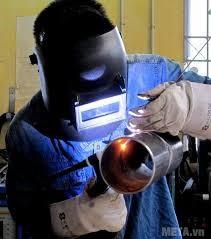
Welding is currently one of the most in-demand occupations with highly attractive salaries. Most developed and developing countries have a significant demand for skilled welders. Therefore, students studying this field do not need to worry about employment opportunities after graduation. In addition, training costs are relatively low, the training period is short, income is high, and career advancement opportunities are considerable. One major advantage of studying Welding is that the training duration is short and does not require extensive theoretical thinking, but rather diligence, regular practice, and quick technical operations.
By studying Welding, learners can independently design and manufacture mechanical products using conventional equipment such as arc welding machines, as well as advanced automatic welding technologies such as MIG, TIG, and welding robots in various welding positions. Products created in the welding field include metal products made from steel, copper, aluminum, and commonly used items such as gates, steel doors, scaffolding, tables and chairs, steel frame structures, shipbuilding, automobile assembly, and equipment manufacturing for thermal power plants, hydropower plants, and oil refineries.
Currently, the government supports 70% of the tuition fee for the entire course for students in this field (except for students in the “9+” category, meaning lower secondary school graduates who receive 100% tuition support for the entire course).
Working Competencies
– Ability to fabricate welding blanks according to technical drawing requirements using manual gas cutting torches and automatic gas cutting machines;
– Ability to assemble welding structures in different positions according to technical requirements;
– Ability to operate and adjust welding parameters on welding machines (SMAW, MAG/MIG, TIG);
– Ability to proficiently connect welding equipment (SMAW, MAG/MIG, TIG);
– Ability to select appropriate welding parameters for different welding methods (SMAW, MAG/MIG, TIG);
– Ability to perform manual arc welding (SMAW) for simple and complex structures, including fillet welds (1F – 3F), groove welds (1G – 3G), and pipe welds (1G, 2G, 5G) on carbon steel in accordance with technical drawing requirements;
– Ability to perform MAG/MIG welding in positions 1F – 3F and 1G – 3G meeting technical standards;
– Ability to perform basic TIG welding;
– Ability to repair defective welds and identify causes, corrective actions, and preventive measures;
– Ability to work independently and in teams;
– Ability to handle technical situations encountered in practical construction and manufacturing work;
– Ability to maintain equipment and tools and implement fire and explosion prevention measures in welding operations.
Job Positions
Currently, Welding has a broad employment market nationwide, providing graduates with extensive career opportunities. Graduates can work in positions such as production team leader, workshop technician, lathe operator, welder, and milling technician in enterprises and factories in industries such as:
- Oil and gas industry
- Shipbuilding and high-speed railway manufacturing industry
- Aircraft industry
- Petrochemical and chemical industry
- Hydropower and thermal power industry
- Cement industry
- Bridge and tunnel construction industry
- Steel structure and factory fabrication industry
- Industrial machinery manufacturing industry
+ Start their own businesses by opening workshops or manufacturing facilities;
+ Participate in overseas labor markets.
Further Study Opportunities After Graduation
Students majoring in Welding also have many opportunities for further education and professional development.
They may pursue articulation programs to obtain higher qualifications in related specialties.
They are capable of learning and applying new technologies and technical advancements in welding technology.
They are also capable of self-study, accumulating practical experience, improving professional and technical expertise, and maintaining lifelong learning awareness.
Contact Information
Faculty of Technology Practice
Dean: Mr. Le Ngoc Dinh
Phone: 0905 406 363
Email: dinhln@caodanggtvt2.edu.vn
(Article and photos by: Luong Duyen Hai)
- Report on the results of self-assessment of training program quality – College level
- Central Transport College No. 5 looks forward to the election of deputies to the 16th National Assembly and People’s Councils at all levels for the 2026–2031 term
- Welding Technology Program
- Recruitment notice for positions at THACO Chu Lai
- The Youth Union of Central Transport College No. 5 participates in the 2020 Startup and Innovation Festival